

Tanzania Mandatory Travel Insurance starts in October 2026. Learn the cost, coverage, exemptions, how to apply, and Mainland-Zanzibar travel rules.
If you are planning a safari, Kilimanjaro trek, cultural tour, or holiday in Tanzania, there is a new entry requirement you need to include in your travel preparations.
From 1 October 2026, mandatory inbound travel insurance applies to eligible foreign visitors entering Mainland Tanzania through airports, land borders, and seaports. The policy is issued through the National Insurance Corporation of Tanzania (NIC) and is separate from a visa or any private travel insurance you may already have.
The standard premium is USD 44 per visitor, and the policy provides cover for up to 92 days, including multiple entries during the policy period, subject to the applicable terms and conditions.
This new requirement is particularly important for travelers arriving at Kilimanjaro International Airport (JRO) for a Tanzania safari or Mount Kilimanjaro climb, as well as visitors entering through Dar es Salaam, Arusha, land borders, or other Mainland entry points.
This guide explains the Tanzania Mandatory Travel Insurance requirement, who needs it, what it covers, how to purchase it, what happens if you already have travel insurance, and how the requirement works when your itinerary includes both Mainland Tanzania and Zanzibar.
What Is the New Tanzania Mandatory Travel Insurance Requirement?
The Government of Tanzania has introduced Inbound Travel Insurance for foreign visitors entering Mainland Tanzania.
The requirement officially took effect on 1 October 2026, following the publication of the Inbound Travel Insurance Regulations for Foreign Visitors Entering Mainland Tanzania under Government Notice No. 256 of 2026.
Foreign visitors entering Mainland Tanzania by air, land, or sea are required to obtain the prescribed inbound travel insurance, subject to applicable exemptions.
For travelers arriving in Mainland Tanzania, the designated provider is the National Insurance Corporation (NIC). Travelers whose first point of entry is Zanzibar obtain the corresponding inbound insurance through the Zanzibar Insurance Corporation (ZIC).
The Ministry of Finance has advised international travelers to arrange the required insurance before traveling in order to make entry procedures easier and reduce the possibility of delays on arrival.
The official Mainland policy costs the Tanzanian shilling equivalent of USD 44 per visitor and is valid for up to 92 days.
Tanzania Mandatory Travel Insurance at a Glance
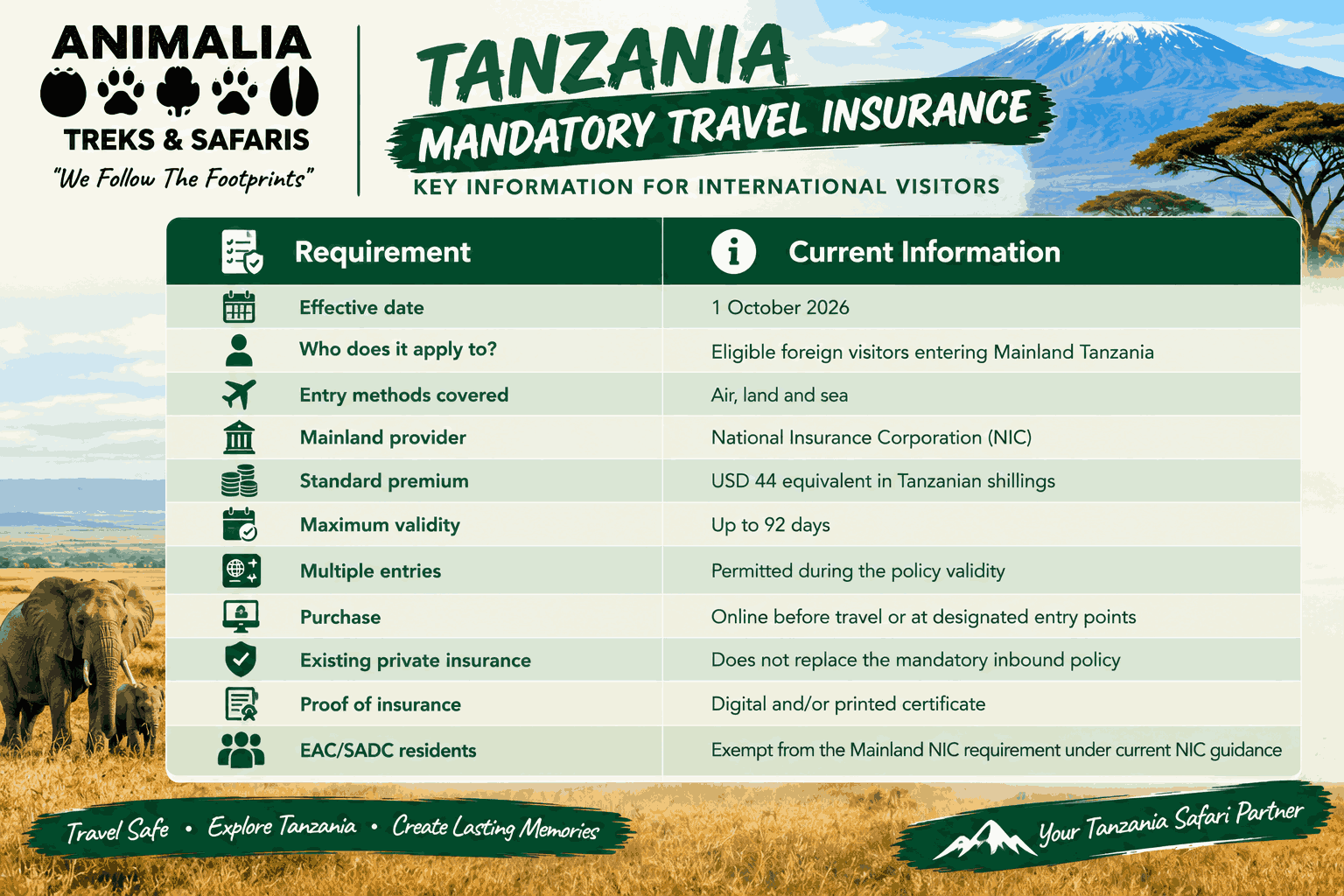
The exact policy benefits and conditions are governed by the insurance policy, so travelers should review the certificate and terms rather than assuming that every possible travel expense is covered.
Who Needs Tanzania Mandatory Travel Insurance?
The requirement applies to foreign nationals entering Mainland Tanzania through airports, land borders, and seaports, subject to the applicable exemptions.
This means the requirement can affect travelers arriving for many different purposes, including a:
- Tanzania safari
- Mount Kilimanjaro climb
- Mount Meru trek
- Cultural or community tourism experience
- Business or leisure trip
- Beach holiday on the Mainland coast
- Combined Tanzania safari and Zanzibar holiday
For example, a traveler flying into Kilimanjaro International Airport before starting a Serengeti safari or climbing Mount Kilimanjaro should arrange the applicable Mainland inbound insurance.
Likewise, someone arriving through Julius Nyerere International Airport in Dar es Salaam before traveling to Nyerere National Park, Zanzibar, or other destinations will need to consider the Mainland requirement if they are not covered by an applicable exemption.
Are EAC and SADC Residents Exempt?
Yes. Current NIC guidance states that the Mainland mandatory inbound insurance excludes foreign nationals who are residents of East African Community (EAC) Partner States or Southern African Development Community (SADC) Partner States.
The important wording is residents, so travelers should not automatically assume that nationality alone determines whether they are exempt. If you believe you qualify for an exemption, check your circumstances and supporting documentation before traveling.
Because the implementation is new, travelers with unusual immigration or residency circumstances should confirm their position with the relevant Tanzanian authorities or insurance provider before departure.
How Much Does Tanzania Travel Insurance Cost?
The standard Mainland inbound travel insurance premium is currently USD 44 per visitor, payable in the Tanzanian shilling equivalent.
This is a separate travel cost from your Tanzania visa, flights, accommodation, safari, park fees, Kilimanjaro climbing costs, or other holiday expenses.
For a couple, for example, the standard premium would be USD 88 if both travelers are required to purchase the policy. A family or group should check the applicable current rates when applying, particularly if traveling with children.
The official NIC FAQ currently confirms the USD 44 standard premium but does not provide the complete family pricing structure on that page, so travelers should check the live insurance portal rather than relying on older figures circulating online.
What Does the Tanzania Inbound Travel Insurance Cover?
The mandatory policy is intended to provide financial protection when certain unexpected situations occur during a visitor’s stay.
Current NIC information identifies protection relating to medical emergencies, loss of luggage, emergency medical evacuation, and repatriation, subject to the policy terms and conditions.
This is particularly relevant to Tanzania travelers because a safari or trekking itinerary can take visitors far from major urban centers. A medical emergency during a safari, an accident while traveling, or the need for emergency transportation can create significant logistical and financial challenges.
The policy is therefore intended to provide an additional layer of protection during the trip.
However, travelers should understand an important distinction: mandatory inbound insurance should not automatically be treated as a complete replacement for comprehensive travel insurance.
The mandatory policy is an entry requirement with defined benefits and conditions. Your own comprehensive travel insurance may provide broader protection depending on the policy, including areas such as trip cancellation, interruption, personal belongings, higher medical limits, personal liability, or specialist activities.
Anyone planning a Mount Kilimanjaro climb, for example, should carefully check whether their separate travel insurance specifically covers high-altitude trekking and mountain-related emergencies.
Does Existing Travel Insurance Replace the Tanzania Mandatory Policy?
No.
One of the most important things travelers need to understand is that having an existing international travel insurance policy does not remove the requirement to obtain the prescribed inbound travel insurance.
The mandatory policy is a separate Tanzanian entry requirement.
Therefore, a traveler who has already purchased comprehensive travel insurance through an international insurer, bank, credit card provider, employer, or another company may still need to obtain the Tanzania inbound policy if they are subject to the requirement.
It is useful to think of the two policies differently.
Your mandatory inbound insurance satisfies the applicable Tanzanian entry requirement, while your private comprehensive travel insurance can provide additional protection according to its own terms.
For this reason, travelers should avoid cancelling their existing comprehensive policy simply because they have purchased the mandatory Tanzanian cover.
When Should You Buy Tanzania Mandatory Travel Insurance?
Travelers are strongly advised to arrange the insurance before traveling to Tanzania.
NIC’s current guidance states that foreigners should obtain the inbound insurance before arrival, and proof of coverage may be required for verification when entering the country.
The Ministry of Finance has similarly advised international travelers to make the necessary arrangements before traveling to help facilitate entry procedures and avoid unnecessary delays.
Buying the policy in advance also gives you time to check that your personal information, passport details, travel dates, and entry point have been entered correctly.
After purchasing the policy, keep your certificate somewhere that is easy to access. A digital copy on your phone is useful, but carrying a printed copy can also be a sensible backup when traveling.
Where Can You Buy Tanzania Mandatory Travel Insurance?
Travelers entering Mainland Tanzania can purchase the inbound travel insurance through the official NIC online portal before traveling.
The current NIC FAQ also states that insurance can be purchased upon arrival at entry points, with online payment available by debit or credit card and payment on arrival available by cash. However, purchasing in advance is recommended because it allows travelers to arrive with their certificate already prepared.
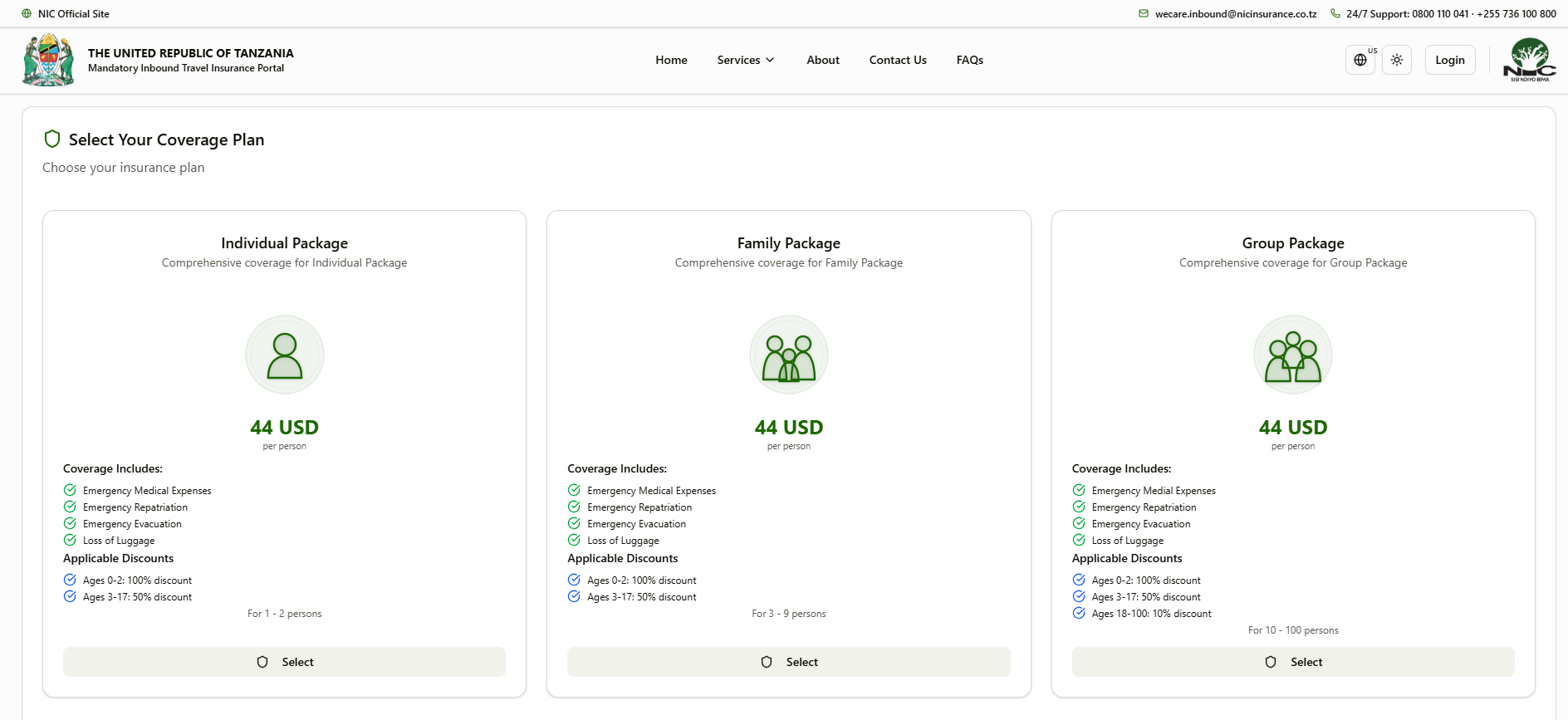
What Information Do You Need?
The application requires basic information needed to issue the policy. Current NIC guidance identifies information such as:
- Passport details
- Travel dates
- Purpose of the visit
- Basic personal information
Travelers should make sure the information entered during the application matches their passport and travel arrangements.
If your travel dates or passport information change after purchasing the policy, check with NIC about what needs to be updated before traveling.
Can You Buy the Insurance on Arrival in Tanzania?
Yes.
The current NIC information confirms that the inbound travel insurance can be purchased at entry points as well as online.
Nevertheless, buying it before departure is the better option for most international travelers.
Arriving at an airport after a long international flight is already a busy part of the journey. Having your insurance certificate ready can help reduce additional administrative steps and make the arrival process more straightforward.
This is especially useful for travelers with tight connecting flights, airport transfers, domestic flights, safari schedules, or a pre-arranged Kilimanjaro transfer.
What Happens After You Purchase the Insurance?
NIC issues a digital and/or printed insurance certificate that can be used as proof of coverage.
Keep the certificate accessible throughout your trip.
You may want to save it in several places, such as your phone, email, and travel documents. If you are traveling as a family, each traveler should have the relevant policy information available.
The policy becomes effective immediately upon payment according to current NIC guidance, while the actual coverage period is based on the dates shown on the policy certificate.
How Long Is the Tanzania Inbound Insurance Valid?
The Mainland inbound policy provides coverage for up to 92 days.
The policy also permits multiple entries during its validity period, according to the current NIC FAQ.
This can be useful for travelers whose itinerary includes leaving and returning to Tanzania during the same policy period, although travelers should always check that their individual certificate remains valid for their planned dates and movements.
If you intend to stay longer than the original policy period, NIC currently states that an extension can be arranged before the policy expires.
Do not simply assume that your original insurance will automatically remain valid beyond the dates shown on the certificate.
What If You Are Staying in Tanzania for More Than 92 Days?
The standard inbound policy covers up to 92 days.
If your travel plans extend beyond the policy period, you should contact NIC before the policy expires to determine whether an extension is available and what conditions apply.
This is particularly important for travelers undertaking longer stays, extended cultural or business trips, or combining tourism with other lawful activities.
Your immigration status and insurance validity are separate matters, so an insurance extension should not be confused with extending your permission to remain in Tanzania.
Mainland Tanzania or Zanzibar: Which Insurance Do You Need?
This is one of the most important questions for travelers planning a Tanzania safari followed by Zanzibar.
The answer depends on your first point of entry into the United Republic of Tanzania.
If your international journey begins by entering Mainland Tanzania, the applicable inbound insurance is obtained through NIC.
If your international journey begins by entering Zanzibar, the applicable inbound insurance is obtained through ZIC, the Zanzibar Insurance Corporation.
 The current government and NIC guidance confirms that travelers combining Mainland Tanzania and Zanzibar do not need to purchase two separate inbound policies simply because their itinerary includes both destinations. The policy is determined by the traveler’s first point of entry, subject to the applicable terms and conditions.
If You Enter Mainland Tanzania First
Suppose your itinerary is:
International flight → Kilimanjaro International Airport → Serengeti → Ngorongoro → Zanzibar
In this case, Mainland Tanzania is your first point of entry.
You should obtain the NIC inbound travel insurance.
After completing your Mainland safari and traveling onward to Zanzibar, you do not need to purchase a second inbound policy simply because you are continuing your trip to Zanzibar, provided your existing policy is valid and applicable.
If You Enter Zanzibar First
Now consider a different itinerary:
International flight → Zanzibar → Mainland Tanzania safari → Kilimanjaro
In this case, Zanzibar is your first point of entry.
You should obtain the applicable ZIC inbound travel insurance.
The current guidance states that travelers who enter through Zanzibar first and subsequently travel to Mainland Tanzania do not need to purchase the mandatory insurance again simply because they continue their journey to the Mainland.
The practical lesson is simple: look at where you first enter Tanzania before purchasing the policy.
Tanzania Travel Insurance for Safari Travelers
For safari travelers, the new insurance requirement should be added to the planning checklist alongside your visa, flights, accommodation, safari arrangements, and other travel documents.
If you are flying directly into Kilimanjaro International Airport for a Northern Tanzania safari, for example, you should arrange the applicable Mainland insurance before departure.
Your safari itinerary may take you through destinations such as Tarangire National Park, Ngorongoro Conservation Area and Serengeti National Park, where access to medical facilities may not be as immediate as in a major city.
This makes appropriate travel insurance particularly valuable, although the mandatory policy should still be understood according to its specific terms rather than being assumed to cover every possible safari-related expense.
Travelers should also retain their separate comprehensive travel insurance if they have one.

Tanzania Travel Insurance for Kilimanjaro Climbers
Anyone planning to climb Mount Kilimanjaro should pay particular attention to the difference between mandatory inbound insurance and specialist trekking insurance.
The mandatory Tanzania policy is an entry requirement. A Kilimanjaro climber may also want comprehensive travel insurance that specifically addresses trekking at high altitude and the risks associated with mountain activities.
Before your trek, check the terms of your travel insurance carefully. Look for provisions relating to:
- High-altitude trekking
- Emergency medical treatment
- Mountain evacuation
- Repatriation
- Trip cancellation or interruption
- Baggage and personal belongings
The fact that you have purchased the mandatory Tanzania inbound policy does not mean every aspect of a Kilimanjaro expedition is automatically covered.
Tanzania Travel Insurance and Visa Requirements
The mandatory insurance is separate from the Tanzania visa.
Most visitors who require a visa should still complete the appropriate visa process in accordance with their nationality and purpose of travel.
Tanzania Immigration currently states that tourism visitors generally use an Ordinary Visa, except U.S. passport holders, who are required to apply for a Multiple Visa for tourism. The Ordinary Visa fee is USD 50, while the Multiple Visa fee is USD 100, subject to the applicable immigration rules.
Travelers should therefore think of their entry preparation as several separate requirements rather than assuming that one document replaces another:
Passport + appropriate visa + mandatory inbound insurance where applicable + health documentation where applicable.
Visa requirements can vary according to nationality, so travelers should check the current Tanzania Immigration guidance before applying.
Do You Need a Yellow Fever Certificate for Tanzania?
Yellow fever requirements are separate from the new mandatory travel insurance requirement.
Tanzania’s Ministry of Health maintains yellow fever entry requirements for travelers arriving from certain yellow-fever-risk countries. Travelers arriving from countries on the applicable list may be required to present a valid yellow fever vaccination certificate.
This does not mean that every visitor to Tanzania needs a yellow fever vaccination certificate.
If you are traveling through another country before Tanzania, pay particular attention to your transit history and the applicable health requirements. The Ministry of Health’s published guidance identifies countries from which a valid yellow fever vaccination certificate is required for entry.
Is the New Insurance the Same as Normal Travel Insurance?
No.
This distinction is worth emphasizing because many travelers already purchase travel insurance before an international holiday.
The Tanzania Mandatory Travel Insurance is a specific inbound insurance requirement connected to entry into Tanzania.
Your normal travel insurance is a separate insurance contract that you may purchase for broader travel protection.
A comprehensive international policy can potentially provide benefits that are not included in the mandatory inbound policy, depending on its terms and coverage limits.
For that reason, travelers should not look at the USD 44 inbound policy as a complete substitute for comprehensive travel insurance.
Instead, consider the mandatory policy as one of the entry requirements for your Tanzania journey and your broader travel insurance as additional protection for the wider trip.
What Should Travelers Do Before Flying to Tanzania?
A few simple preparations can make the new requirement much easier to manage.
First, determine where you will first enter Tanzania. If you arrive on the Mainland, check the NIC requirement. If your first arrival is in Zanzibar, check the ZIC requirement.
Next, purchase the appropriate insurance through the official provider before departure where possible.
Check your passport details, travel dates, and other information carefully before completing the application.
Once the policy has been issued, save your insurance certificate digitally and keep a printed copy with your travel documents.
Finally, do not forget that the mandatory inbound insurance does not necessarily replace your existing comprehensive travel insurance. If you already have a policy, keep it and check whether it covers the activities you plan to undertake, particularly if you will be climbing Mount Kilimanjaro or participating in other adventure activities.

Tanzania Mandatory Travel Insurance: A Simple Example
Imagine a traveler from Europe planning this itinerary:
Europe → Kilimanjaro International Airport → Tarangire → Ngorongoro → Serengeti → Zanzibar → Europe
Because the traveler first enters Tanzania through Mainland Tanzania, they should obtain the applicable NIC inbound travel insurance before traveling.
They can then continue to Zanzibar during the same trip without purchasing a second inbound policy solely because they have crossed from Mainland Tanzania to Zanzibar, provided the existing policy remains valid and applicable.
Now consider a traveler whose itinerary begins:
Europe → Zanzibar → Mainland Tanzania → Serengeti → Kilimanjaro → Europe
In this situation, Zanzibar is the first point of entry, so the traveler should obtain the applicable ZIC inbound travel insurance. They can then continue to Mainland Tanzania without purchasing another mandatory policy solely because they have moved between Zanzibar and the Mainland.
Frequently Asked Questions About Tanzania Mandatory Travel Insurance
Is Tanzania travel insurance mandatory from October 2026?
Yes. From 1 October 2026, eligible foreign visitors entering Mainland Tanzania are required to obtain the prescribed inbound travel insurance, subject to applicable exemptions.
How much does mandatory Tanzania travel insurance cost?
The standard Mainland premium is USD 44 per visitor, payable in the Tanzanian shilling equivalent.
Is the USD 44 insurance fee per person?
Yes. The current NIC FAQ describes the premium as USD 44 per person.
Is Tanzania mandatory travel insurance required if I already have travel insurance?
Yes. Your existing private or international travel insurance does not replace the mandatory inbound policy where the Tanzanian requirement applies.
Can I buy the insurance after arriving in Tanzania?
Yes. NIC states that the policy can be purchased online or upon arrival at entry points. However, travelers are strongly advised to arrange it before traveling to help avoid delays during entry procedures.
How long is Tanzania mandatory travel insurance valid?
The policy provides coverage for up to 92 days, with multiple entries permitted during the validity period, subject to the policy dates and terms.
Can I extend the insurance if I stay longer than 92 days?
NIC currently states that extensions can be arranged before the policy expires. Travelers planning a longer stay should contact NIC in advance rather than allowing the original policy to expire.
Do I need both NIC and ZIC insurance if I visit Mainland Tanzania and Zanzibar?
No. Current NIC guidance states that travelers combining Mainland Tanzania and Zanzibar need one inbound policy based on their first point of entry, subject to the applicable terms and conditions.
Which insurance do I need if I arrive at Kilimanjaro International Airport?
If Kilimanjaro International Airport is your first point of entry into Tanzania, you are entering through Mainland Tanzania and should obtain the applicable NIC inbound travel insurance, unless you fall under an exemption.
Do EAC and SADC residents need the Mainland Tanzania insurance?
Current NIC guidance states that foreign nationals who are residents of EAC or SADC Partner States are exempt from the Mainland inbound insurance requirement. Travelers should ensure that they can demonstrate their qualifying residency status if necessary.
Does the mandatory insurance cover my entire safari?
It provides specified insurance benefits, including medical emergencies, emergency medical evacuation or repatriation and loss of luggage, subject to the policy terms and conditions. Travelers should not assume that every safari expense, cancellation, activity, or circumstance is automatically covered.
Do I still need comprehensive travel insurance?
It is strongly advisable to maintain appropriate comprehensive travel insurance in addition to the mandatory inbound policy, particularly for travelers who need protection beyond the specific benefits provided by the mandatory cover.
What should Kilimanjaro climbers know about the insurance?
Kilimanjaro climbers should pay particular attention to whether their broader travel insurance covers high-altitude trekking and mountain evacuation. The mandatory inbound insurance should not automatically be assumed to provide every type of specialist trekking protection.
Where can I get the official Mainland Tanzania insurance?
For visitors entering Mainland Tanzania, use the official National Insurance Corporation inbound travel insurance portal rather than relying on unofficial third-party websites.
What documents should I keep with me?
Keep your passport, visa or visa documentation where applicable, inbound insurance certificate, flight information, and any required health documentation accessible throughout your journey.
Final Advice for Travelers to Tanzania
The introduction of mandatory inbound travel insurance is an important change to Tanzania’s travel requirements from October 2026.
For most international visitors entering Mainland Tanzania, the process is straightforward: determine whether you are subject to the requirement, obtain the appropriate policy through the official provider, keep your certificate accessible, and continue to maintain any broader travel insurance you already have.
If you are planning a safari, Kilimanjaro climb, or a combined Mainland Tanzania and Zanzibar holiday, it is best to include the insurance in your travel planning from the beginning rather than waiting until you reach the airport.
Most importantly, check your first point of entry. Travelers arriving on Mainland Tanzania should follow the NIC process, while those entering through Zanzibar should follow the applicable ZIC process. If your itinerary includes both, current guidance indicates that you need only one inbound policy based on your first point of entry.
Travel requirements can change, so travelers should always verify the latest information with the relevant Tanzanian authorities and insurance provider shortly before departure.
For travelers booking a Tanzania safari or trekking adventure with Animalia Treks and Safaris, we recommend checking your entry documents and insurance arrangements well before your arrival date so that your journey can begin as smoothly as possible.