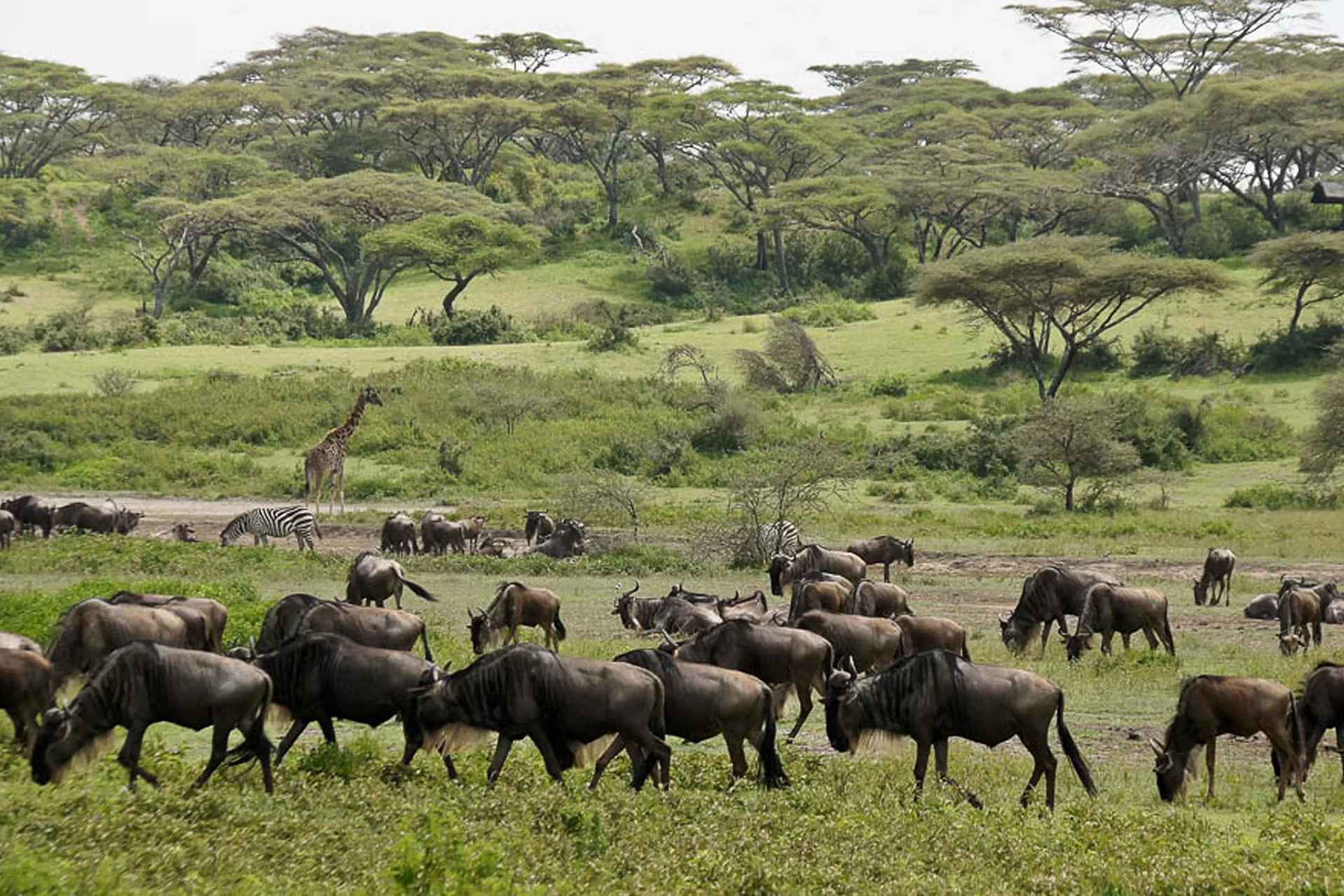
The Ndutu calving season is one of the most remarkable wildlife experiences in Tanzania. Every year, hundreds of thousands of wildebeest gather across the short-grass plains of the southern Serengeti and the Ndutu area of the Ngorongoro Conservation Area, creating one of the most dramatic periods of the Great Wildebeest Migration.
For wildlife enthusiasts, photographers and first-time safari travelers, this period offers an opportunity to see much more than large herds moving across the plains. The calving season is a time of newborn animals, predator activity, dramatic landscapes and constantly changing wildlife encounters.
The exact timing varies with rainfall and local conditions, but the calving period generally occurs during the first months of the year. During this time, the southern Serengeti and Ndutu plains become particularly important for the migrating herds.
At Animalia Treks and Safaris, we help travelers plan safari experiences around the migration while allowing flexibility for the natural movement of wildlife. Because the migration is a natural event rather than a fixed attraction, understanding the season and choosing the right itinerary are important when planning a Ndutu safari.
What Is the Ndutu Calving Season?
The Ndutu calving season is the period when large numbers of wildebeest give birth after gathering in the short-grass plains of the southern Serengeti ecosystem.
The southern Serengeti and Ndutu region provide important grazing areas during this stage of the annual migration cycle. The availability of fresh grass following seasonal rains helps support the large herds.
The calving period is particularly famous because a very large number of wildebeest calves are born over a relatively short period.
This creates a completely different safari atmosphere compared with other stages of the migration.
Instead of focusing primarily on river crossings or long-distance herd movements, visitors during the Ndutu season can experience vast concentrations of animals spread across open grasslands, with newborn calves and predators creating frequent wildlife encounters.

When Is the Ndutu Calving Season?
The Ndutu calving season generally takes place around January, February and into March, although the exact timing can vary from year to year depending on rainfall and grazing conditions.
The most commonly associated period for peak calving is February, but visitors should understand that wildlife does not follow a strict calendar.
Rainfall plays an important role in determining where the herds gather and how long they remain in a particular area.
This means that a safari planned around Ndutu should not be based solely on a particular date.
Experienced safari operators monitor seasonal conditions and wildlife movements when planning itineraries.
Why the timing can change
The Great Wildebeest Migration is driven by ecological conditions, particularly the availability of water and nutritious grazing.
If rainfall patterns change, the location and timing of the herds can also change.
For this reason, nobody can guarantee that a particular road, plain or viewpoint will contain large herds on a specific day.
A good safari itinerary allows enough time and flexibility to maximize the opportunity for wildlife encounters.
Why Is Ndutu Calving Season Special?
The calving season creates a unique combination of wildlife experiences.
The sheer concentration of wildebeest is impressive, but the most memorable aspect for many visitors is seeing the beginning of a new generation.
Newborn calves can often be seen staying close to their mothers, learning to walk and moving with the herd.
The presence of large numbers of young animals also attracts predators.
Lions, cheetahs, hyenas and other predators take advantage of the abundance of vulnerable young prey.
This creates an intense and dynamic wildlife environment.
However, it is important to remember that predator sightings are never guaranteed. Wildlife is unpredictable, and sightings depend on location, timing, weather and animal behaviour.
The Great Wildebeest Migration and Ndutu
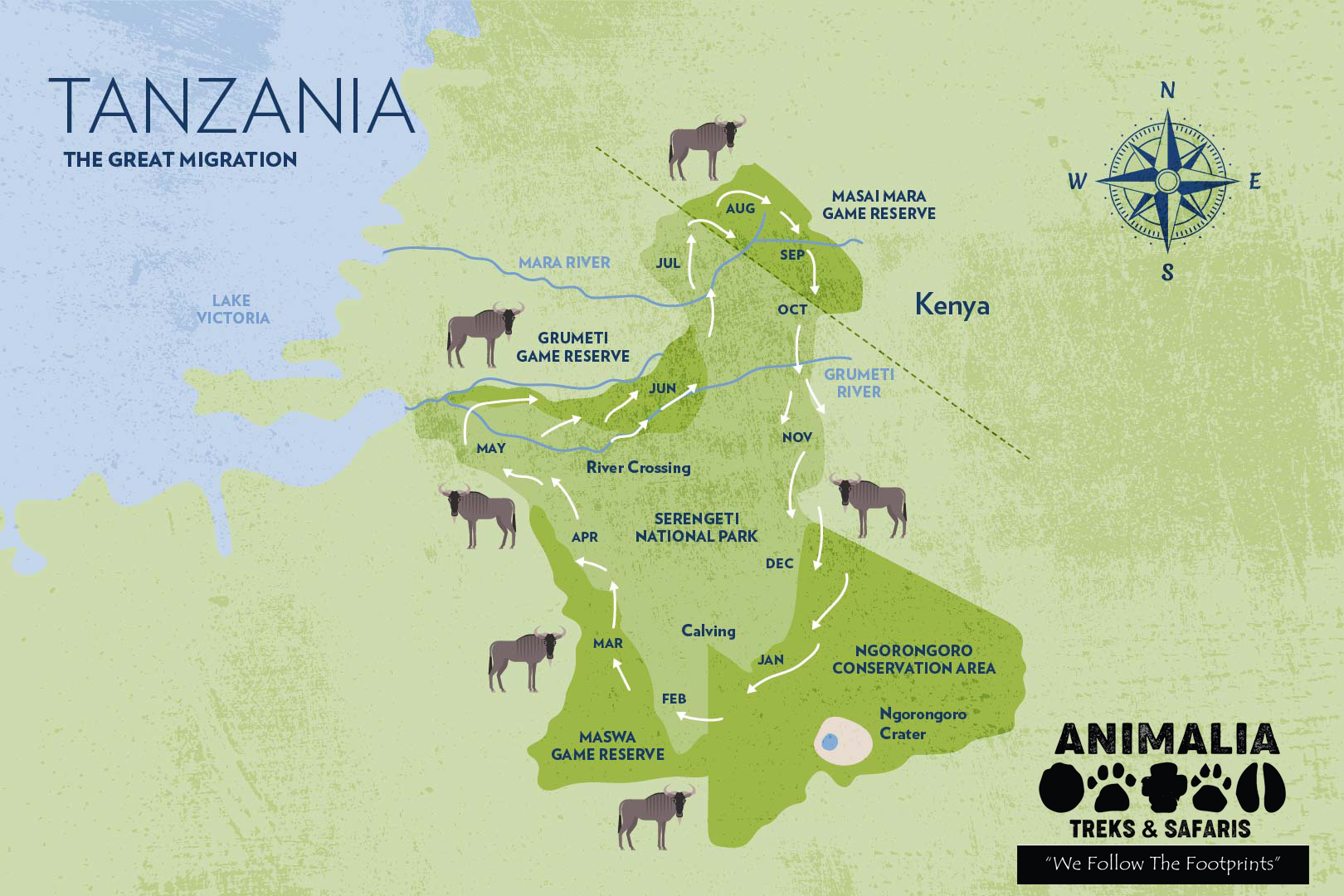
The Ndutu calving season is one stage in the larger annual cycle of the Great Wildebeest Migration.
The migration involves enormous numbers of wildebeest and other grazing animals moving through the Serengeti ecosystem and, at different times, the Masai Mara ecosystem in Kenya.
The animals move in response to changing grazing and water conditions.
The cycle is not simply a straight-line journey from one destination to another.
Herds can spread across large areas, divide into smaller groups and change direction depending on environmental conditions.
This is why the Ndutu experience should be viewed as part of a much larger ecological process.
Where Is Ndutu?
Ndutu lies in the southern part of the greater Serengeti ecosystem, close to the boundary between the Serengeti National Park and the Ngorongoro Conservation Area.
The landscape is characterized by open grasslands, seasonal water sources and scattered woodland.
Its position makes it an important area during the early part of the migration cycle.
For safari travelers, the location is also useful because a Ndutu itinerary can be combined with other major northern Tanzania destinations.
Depending on the itinerary, travelers may visit the Ngorongoro Crater, Serengeti National Park and Tarangire National Park as part of a longer safari.
What Can You See During Ndutu Calving Season?
One of the biggest attractions of the season is the diversity of wildlife encounters.
You may see huge wildebeest herds spread across the plains, often accompanied by zebra and other grazing animals.
The open environment can also make it possible to observe predators searching for opportunities.
Wildebeest and newborn calves
The wildebeest are the stars of the season.
Seeing mothers with newborn calves provides a particularly memorable wildlife experience.
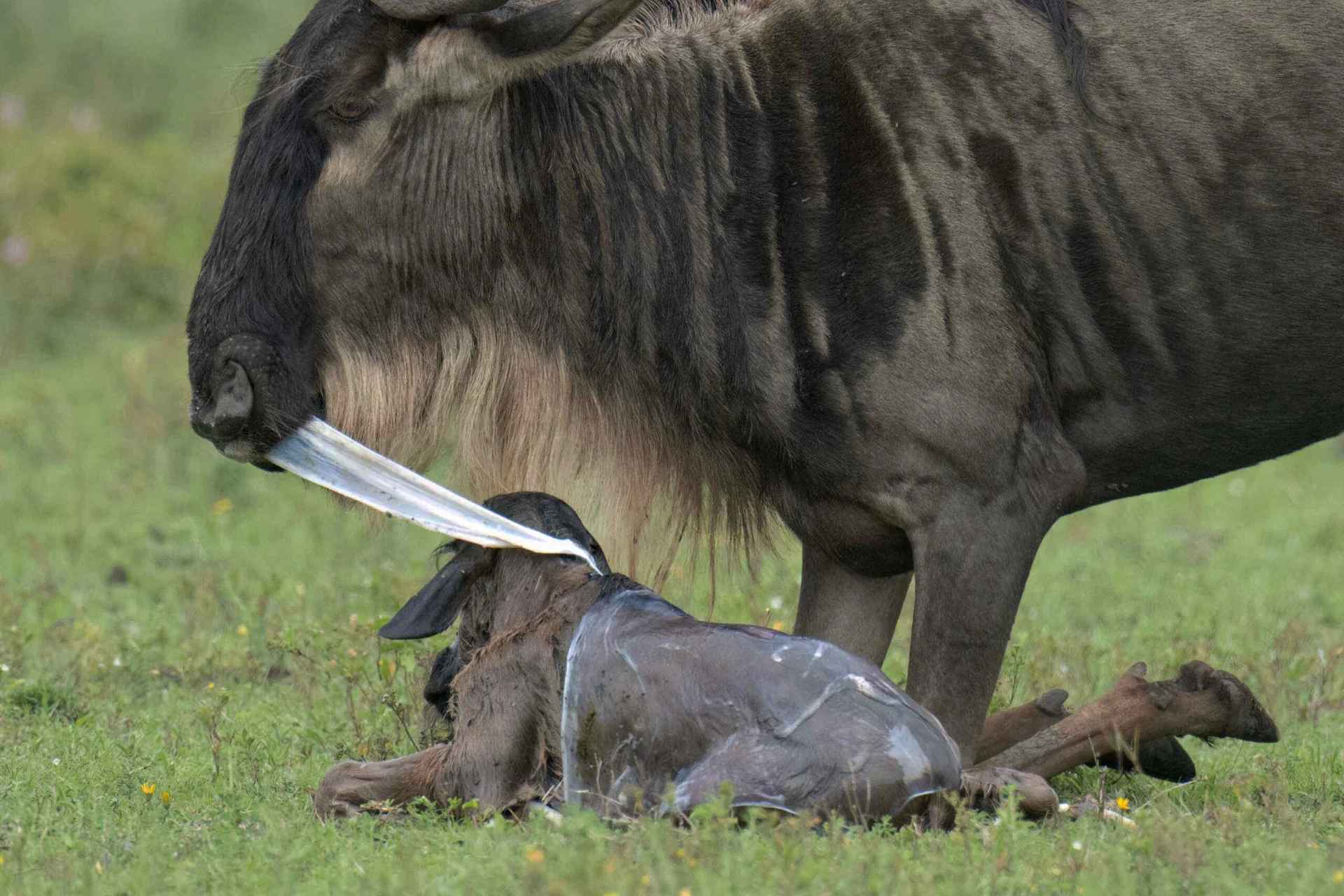
Young calves can sometimes be seen standing only shortly after birth and gradually becoming more active as they grow stronger.
The scale of the herds can be difficult to appreciate until you see the animals stretching across the landscape.
Zebra
Zebra often move alongside wildebeest and can be encountered in significant numbers during the migration cycle.
Their contrasting black-and-white patterns create excellent photographic opportunities against the golden grasslands.
Lions
The concentration of prey can attract lions into areas where migrating herds are gathered.
Lion sightings are among the possibilities during a Ndutu safari, although their exact location and behaviour change constantly.
A good guide will use knowledge of the area, recent sightings and animal behaviour to search for wildlife.
Cheetahs
The open plains of the Ndutu area can provide suitable habitat for cheetahs.
Their hunting behaviour can be fascinating to observe, particularly when they are moving through open grassland.
As with all wildlife sightings, however, there is no guarantee that a particular animal will be seen on a particular day.
Hyenas
Spotted hyenas are another important predator in the ecosystem.
They can be encountered around the plains and may take advantage of the large numbers of prey animals available during the calving period.
Their social behaviour and interactions can make for interesting safari observations.

Birds of prey and other birdlife
The Ndutu ecosystem also supports a variety of bird species.
Visitors may encounter vultures, eagles, secretary birds, storks and other species during game drives.
The presence of predators and large herbivore herds can create particularly interesting opportunities to observe scavenging birds and birds of prey.
Witnessing a Wildebeest Birth
One of the experiences people often associate with the calving season is witnessing a wildebeest giving birth.
If this happens during your safari, it can be an extraordinary natural-history experience.
However, births happen quickly and unpredictably.
A safari operator cannot guarantee that guests will witness an actual birth.
It is better to approach the experience as an opportunity to observe the calving ecosystem rather than expecting a specific event.
You may instead see mothers with very young calves, calves learning to walk or herds moving through the plains.
These encounters can be just as memorable.
Predator Action During the Calving Season
The abundance of young animals creates opportunities for predators.
This is one reason wildlife enthusiasts are particularly interested in the Ndutu period.
Lions, cheetahs, hyenas and other predators are part of the natural ecosystem, and their presence around the herds can create dramatic observations.
However, visitors should remember that these are wild animals behaving naturally.
A safari is not a wildlife show.
Predators may hunt, rest, move away or remain hidden for long periods.
Responsible guides maintain appropriate distances and follow park regulations rather than interfering with animal behaviour.

Photography During Ndutu Calving Season
Ndutu is particularly attractive to wildlife photographers because the season offers a combination of large herds, newborn animals, predators and open landscapes.
The soft light around sunrise and sunset can create beautiful photographic conditions.
Early morning game drives are especially valuable because wildlife is often active during the cooler hours.
A telephoto lens can be useful for photographing animals without getting too close.
Photographers should also remember that a good wildlife photograph is not worth disturbing an animal.
Your guide should position the vehicle responsibly and follow the applicable park rules.
What Makes Ndutu Good for Wildlife Photography?
The open landscape can allow photographers to capture both individual animals and large-scale scenes.
A photograph of a single newborn calf can tell one story, while a wide landscape showing hundreds or thousands of wildebeest can communicate the scale of the migration.
The variety of subjects means photographers can experiment with different compositions throughout the day.
For serious photographers, a private safari vehicle can provide greater flexibility because the itinerary can be adapted around photographic interests.
Best Time to Visit Ndutu for Calving
If your main objective is to experience the calving season, the January to March period is generally the time to consider.
February is particularly associated with the peak calving period, although the exact timing changes according to rainfall and ecological conditions.
Rather than focusing only on one week, consider allowing several days in the Ndutu area.
More time increases the opportunity to observe different wildlife behaviour and changing herd movements.
How Many Days Do You Need for a Ndutu Safari?
There is no fixed answer because it depends on what else you want to see in Tanzania.
For travelers specifically interested in the migration, three or more nights in the Ndutu area can provide a much more immersive experience than visiting for only one game drive.
This gives your guide more opportunities to search different areas and respond to recent wildlife movements.
If your trip includes the wider northern safari circuit, a longer itinerary can combine Ndutu with destinations such as Ngorongoro and Tarangire.
For photographers and serious wildlife enthusiasts, additional time in the migration area may be particularly valuable.
Combining Ndutu With Ngorongoro Crater
One of the advantages of a northern Tanzania safari is that Ndutu can be combined with the Ngorongoro Crater.
The crater offers a very different wildlife environment, with a large concentration of wildlife within its enclosed ecosystem.
A safari itinerary can therefore provide contrasting experiences rather than relying entirely on the migration.
After exploring the open plains around Ndutu, the dramatic landscape of the Ngorongoro Crater can provide another memorable part of the journey.
Combining Ndutu With Serengeti National Park
Ndutu and the wider Serengeti can also be incorporated into a longer Serengeti safari.
The Serengeti is enormous, and wildlife distribution changes throughout the year.
A longer itinerary gives travelers more opportunity to experience different landscapes and wildlife habitats.
During the calving season, the southern Serengeti and Ndutu area are particularly relevant to migration-focused itineraries, while the rest of the Serengeti offers its own wildlife experiences.
Is Ndutu Part of Serengeti National Park?
Ndutu is located within the greater Serengeti ecosystem and lies close to the boundary between Serengeti National Park and the Ngorongoro Conservation Area.
This distinction matters when planning accommodation, park fees and the exact route of a safari.
Your safari operator should explain which areas are included in your itinerary and where your accommodation is located.
Where Should You Stay During Ndutu Calving Season?
Accommodation options around Ndutu vary from permanent lodges to seasonal mobile camps.
Seasonal camps can be particularly attractive during the migration because they are positioned according to the seasonal movement of wildlife.
Staying closer to the area where the herds are concentrated can reduce unnecessary driving and provide more time for game viewing.
When choosing accommodation, consider not only the room or tent itself but also its location relative to the areas you want to explore.
For a migration-focused safari, location can make a significant difference to the overall experience.

Is Ndutu Suitable for First-Time Safari Travelers?
Yes.
You do not need previous safari experience to enjoy Ndutu.
In fact, first-time visitors can find the scale and variety of wildlife particularly impressive.
However, it is useful to have realistic expectations.
Wildlife is unpredictable. You may spend hours observing peaceful herds and then suddenly encounter an exciting predator sighting.
Other times, the day may be quieter.
The beauty of safari is that you are observing a living ecosystem rather than following a fixed schedule.
Ndutu Calving Season for Families
Families can also enjoy the Ndutu experience, provided the itinerary is planned around the children’s ages and interests.
Long game drives can be tiring for younger children, so a family safari should include an appropriate balance of wildlife viewing, rest and other activities.
Private safari arrangements can provide greater flexibility because the family is not required to follow the schedule of a larger group.
For families, it can also be helpful to explain the natural behaviour they may see during the calving season, including predator-prey interactions.
Ndutu for Honeymoon and Romantic Safaris
Couples visiting Tanzania can combine Ndutu with a romantic safari itinerary.
The combination of dramatic landscapes, wildlife, sunrise game drives and intimate safari accommodation can create a memorable honeymoon experience.
A Ndutu safari can also be combined with the Ngorongoro Crater and Serengeti before continuing to Zanzibar for several days of beach relaxation.
This creates a complete Tanzania honeymoon combining wildlife and the Indian Ocean.
What Should You Pack for a Ndutu Safari?
Your packing needs will depend on the season and itinerary, but comfortable layered clothing is particularly useful.
Early morning game drives can be surprisingly cool, while temperatures may become warmer later in the day.
A good safari packing approach should include practical clothing, sun protection, comfortable footwear, personal medication, a camera and binoculars.
Neutral or natural-toned clothing can also be useful for a safari environment.
Your operator should provide specific advice based on the season and accommodation type.

Responsible Tourism During the Ndutu Calving Season
The calving season is a sensitive period for wildlife.
Large numbers of animals gather in relatively concentrated areas, which means responsible tourism is particularly important.
Visitors should follow their guide’s instructions, maintain appropriate distances from wildlife and avoid making unnecessary noise.
Vehicles should not surround animals or interfere with natural behaviour.
Do not attempt to approach newborn animals on foot.
The best safari experiences allow wildlife to behave naturally while visitors observe from a safe and respectful distance.
Why a Professional Safari Guide Matters in Ndutu
The Ndutu area can cover large open landscapes, and wildlife movements change constantly.
An experienced guide can make a major difference to the quality of the safari by understanding the terrain, recent sightings and animal behaviour.
Rather than simply driving around looking for animals, a skilled guide can interpret what you are seeing.
A guide may explain why wildebeest are gathered in a particular area, how predators use the landscape or what behaviour indicates that a herd is about to move.
For a migration-focused safari, local knowledge is particularly valuable.
Is Ndutu Calving Season Guaranteed Every Year?
The calving cycle is a regular part of the wildebeest migration, but the exact timing, location and concentration of animals cannot be guaranteed.
Rainfall patterns vary, and the herds respond to environmental conditions.
This is an important point for travelers planning a safari around a specific week.
A responsible operator should explain that wildlife sightings are naturally unpredictable.
The objective is to maximize your opportunity through good timing, sufficient time in the area and experienced guiding—not to promise a particular wildlife event.
Why Choose Animalia Treks and Safaris for a Ndutu Safari?
Planning a migration safari requires more than choosing a destination and booking a vehicle.
At Animalia Treks and Safaris, we can help you design an itinerary around your travel dates, wildlife interests and preferred safari style.
Whether your priority is witnessing the calving season, photographing wildlife, experiencing the wider Great Migration or combining Ndutu with Ngorongoro and Serengeti, the itinerary can be designed around your interests.
We can also combine your safari with Kilimanjaro, Mount Meru or a Zanzibar beach holiday, creating a complete Tanzania travel experience.
The migration is constantly changing, so flexibility is an important part of the journey.
Our goal is to give you the time, guiding and itinerary structure needed to experience the Ndutu ecosystem while respecting the natural environment and wildlife.

Plan Your Ndutu Calving Season Safari
The Ndutu calving season offers a remarkable opportunity to experience the Great Wildebeest Migration at one of its most active stages.
The combination of enormous wildebeest herds, newborn calves, predators, open plains and dramatic African landscapes creates a safari experience that is very different from the famous river crossings later in the migration cycle.
If you are planning your first Tanzania safari, Ndutu can be incorporated into a broader northern circuit itinerary.
For wildlife photographers, couples, families and experienced safari travelers, spending several days in the area allows you to experience the landscape at a natural pace rather than rushing from one destination to another.
Contact Animalia Treks and Safaris to plan a private Tanzania safari around the Ndutu calving season and the Great Wildebeest Migration.
Frequently Asked Questions About Ndutu Calving Season
When is the Ndutu calving season?
The Ndutu calving season generally occurs from January through March, with February commonly associated with the peak calving period. Exact timing can vary depending on rainfall and grazing conditions.
What animals can I see during Ndutu calving season?
Wildebeest are the main attraction, along with newborn calves, zebra and other grazing animals. Predators such as lions, cheetahs and hyenas may also be encountered.
Is February the best month for Ndutu calving?
February is traditionally associated with the peak calving period, but wildlife movements depend on rainfall and environmental conditions. No specific wildlife sighting can be guaranteed.
Can I see a wildebeest giving birth?
It is possible, but births are unpredictable. A safari should be planned around experiencing the wider calving ecosystem rather than expecting to witness a specific birth.
Is Ndutu inside Serengeti National Park?
Ndutu is part of the greater Serengeti ecosystem and lies near the boundary between Serengeti National Park and the Ngorongoro Conservation Area. The exact location of your accommodation and game drives determines which protected area you are visiting.
How many days should I spend in Ndutu?
For travelers focused on the calving season, spending around three or more nights in the area can provide more opportunities to explore different locations and observe changing wildlife activity.
Can I combine Ndutu with Ngorongoro Crater?
Yes. Ndutu and Ngorongoro can be combined in a northern Tanzania safari itinerary, providing two very different wildlife and landscape experiences.
Is Ndutu good for photography?
Yes. The combination of large herds, newborn animals, predators and open landscapes can provide excellent wildlife photography opportunities, particularly during early morning and late afternoon light.
Is Ndutu suitable for a family safari?
Yes, although the itinerary should be adapted to the children’s ages. Private safari arrangements can provide greater flexibility for families.
Can I visit Ndutu during the dry season?
The calving season is generally associated with the first months of the year. Wildlife is present throughout the year, but the character and location of the migration change as the annual cycle progresses.